Dr Angela Wilkinson Opening Address SGCC Symposium on Power System Resilience
As prepared for delivery at the Opening Address of State Grid Corporation of China's Symposium on Power System Resilience
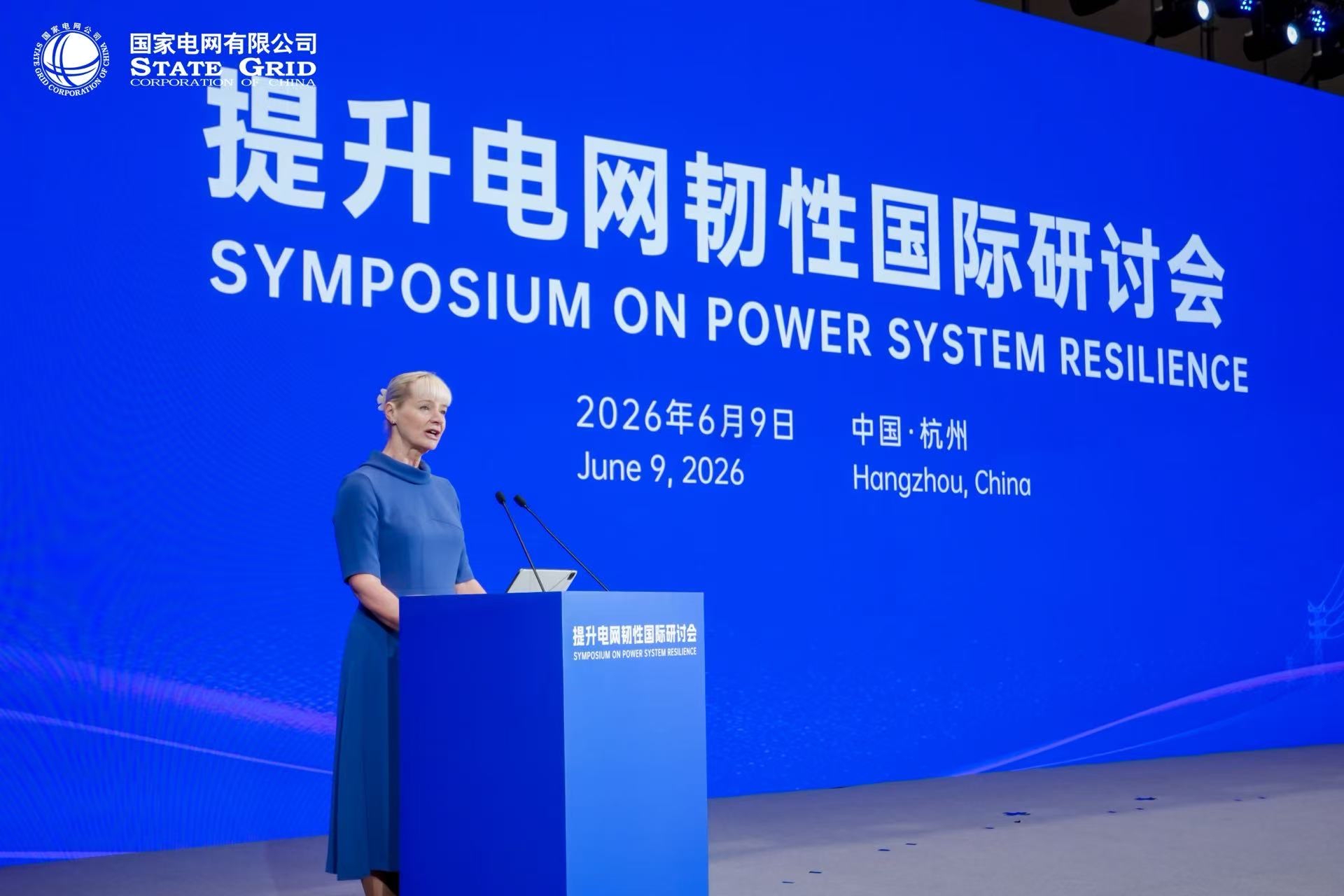
Distinguished leaders and guests of the State Gride Corporation of China…Symposium on Power Grid Resilience.
A very warm greeting to you all here in Hangzhou.
Thank you to SGCC for its patronage and for bringing us together at a moment when the subject of grid resilience has never been more important.
As we meet today, another global energy crisis is unfolding.
The de facto closure of the Strait of Hormuz has disrupted around one-third of global seaborne oil trade and one-fifth of global LNG trade. It is the largest disruption of energy flows in modern history.
While this is a global crisis, it is being felt most acutely in Asia. Many developing economies across wider Asia and Asia-Pacific have been severely impacted and remain the most exposed.
This is a reminder that energy security has not disappeared. It has changed.
At the same time, a new energy future is becoming clearer.
Electrification is accelerating.
Artificial intelligence is increasing demand for clean power.
Climate impacts are testing all parts of the world energy system in new ways.
And geopolitical fragmentation is creating new uncertainties.
In this world, grid resilience is no longer simply an engineering challenge.
It is the new backbone of modern energy civilisation.
The World Energy Council was founded 100 years ago during another period of international strain.
Our founders brought together former adversaries to advance a practical mission: improving the supply and use of energy for the benefit of humanity.
That mission remains as relevant today as it was then.
We are living through a pivotal moment in energy and civilisation. The challenge is not simply to build what comes next.
The challenge is to do so while keep the whole world energy system working and moving forward together.
Our most recent World Energy Issues Monitor highlights a simple reality.
Affordability has become the defining political and social concern in every region.
Energy security has returned to the centre of national decision-making.
And environmental sustainability remains essential for long-term prosperity and human flourishing.
The tensions and trade-offs between these priorities are becoming sharper, not easier.
This brings us to resilience.
The operational bottleneck in the global energy transition is no longer generation.
It is the network itself.
More than 80 million kilometres of transmission and distribution infrastructure must be built or modernised by 2040—equivalent to rebuilding the entire existing global grid.
This is one of the largest infrastructure challenges in human history.
Recent events show why this matters.
In April 2025, the Iberian Peninsula blackout affected millions across Spain and Portugal within hours, disrupting transport, communications, businesses and daily life.
Resilience is no longer a technical issue but a strategic imperative.
This is where China has become one of the world's most important practical examples.
China installed more wind and solar capacity in 2024 than the rest of the world combined.
It operates more than 60,000 kilometres of ultra-high-voltage transmission infrastructure connecting cities, industries and communities across a continental-scale system serving 1.4 billion people.
China is not simply building infrastructure.
It is demonstrating what resilience at scale looks like.
SGCC deserves recognition not only as a technology leader.
It is arguably one of the largest practical coordinators of human and technical systems ever built.
Every day it keeps hundreds of millions of people connected through a system that depends not only on engineering excellence, but also trust, judgement, cooperation and resilience.
These human capabilities matter more than ever.
The world energy system is not a machine that can be engineered and left to run.
It is a living system of people, organisations, institutions and communities.
The most underestimated risks are not technology or finance.
They are trust, skills and institutional capacity.
These cannot be downloaded.
They must be cultivated.
This is why the World Energy Council continues to focus on a simple but demanding leadership task.
Learning how to see the whole system together.
Learning how to continuously rebalance competing priorities together. And learning how to navigate forward together.
For more than two decades, the World Energy Trilemma has helped make visible the tensions between security, affordability and sustainability.
Today we are evolving this work into a practical discipline of rebalancing.
Because tensions and trade-offs do not disappear.
They change.
And they require continuous attention.
The future, however, does not fit neatly within any triangle.
That is why the World Energy Council is exploring a broader framework for future-facing dialogue and intergenerational leadership.
We call this the World Energy Compass. Navigation requires new North Stars – resilience, zero waste and circularity.
As Deng Xiaoping famously observed, progress often involves “crossing the river by feeling the stones”.
Civilisation is now crossing a world energy river whose currents are becoming faster, deeper and less predictable.
The World Energy Trilemma helps us feel the stones.
The World Energy Compass guides us beyond the short term horizon towards new possibilities of abundant energy for human flourishing.
The defining leadership challenge of our time is to find ways to cross that river together.
If world energy fails, civilisation falters.
That is not fatalism; but realism.
And it is also a call to action.
I hope we can continue this conversation when the world energy community gathers in Riyadh for the World Energy Congress in April 2027.
Not simply as participants.
But as world energy leaders committed to strengthening resilience, rebalancing priorities and navigating towards abundant energy for human flourishing and planetary health.
Thank you.
Related Publications

World Energy Issues Monitor | 2026
Published on 26 March 2026
Latest News